How Do AI Agents Handle Multilingual Conversations?
A breakdown of multilingual AI agent design for BFSI: code-switching, utterance-level language detection, KYC completion rates, and Indian language support.
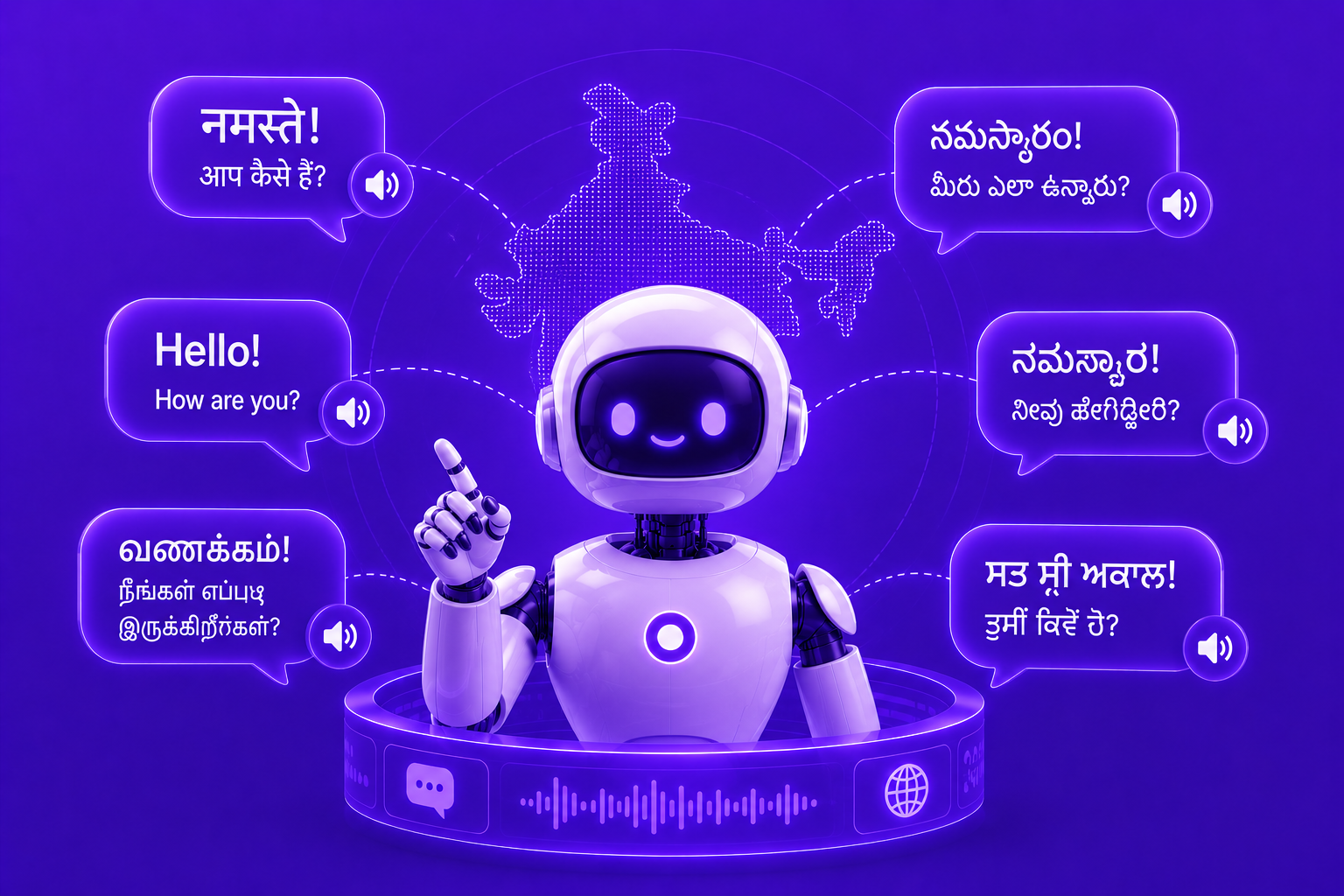
A technical and operational breakdown of multilingual AI agent design for BFSI teams serving India's linguistically diverse customer base.
AI agents handle multilingual conversations through a combination of language detection at the utterance level, model training on code-switched speech, real-time language switching mid-conversation, and context preservation across language boundaries. For BFSI specifically, the challenge is not translation but handling the way Indian customers naturally mix languages within a single sentence, a pattern known as code-switching that standard monolingual models handle poorly. Getting multilingual right is not optional for BFSI institutions serving tier-2 and tier-3 markets. It is a prerequisite for completion rates in KYC, onboarding, and re-engagement workflows.
Why Multilingual Is Not the Same as Translated
A common misconception in AI agent design is that multilingual capability means running the same agent in multiple languages, with separate language-specific models or translation layers. In practice, that architecture fails in BFSI because of how customers actually speak.
In India, a customer on a KYC verification call does not speak either pure Hindi or pure English. They speak Hinglish, Tanglish, Benglish, or whichever regional combination reflects their daily context. Mid-sentence switches between languages are not errors. They are natural conversational patterns. An AI agent that treats them as errors and asks customers to repeat themselves in a single language creates friction at exactly the point in the workflow where drop-off is most costly.
Research published in Nature's Scientific Reports on a bilingual banking assistant found that building effective multilingual banking AI requires training models specifically on the mixed-language patterns of real customer conversations, not on clean single-language corpora. The architecture must handle language detection and switching at the utterance level, not at the session level.
The Code-Switching Problem in Voice AI
Code-switching refers to the practice of moving between two or more languages within a single conversation or within a single sentence. For voice AI, this creates a technical challenge at every stage of the processing pipeline: speech recognition, language understanding, and response generation.
Standard monolingual speech recognition models produce significantly elevated word error rates on code-switched speech compared to single-language input. For BFSI voice AI deployed in India, this matters because word error rate directly affects whether the agent correctly captures the information it needs to complete a KYC verification, update a loan application, or confirm a policy renewal.
The solution is to train ASR (automatic speech recognition) models on real mixed-language conversation data from the relevant deployment context. For Indian BFSI specifically, this means training on actual call recordings from banking and insurance workflows, not on general-purpose speech datasets. Haptik has published that their multilingual voice AI models are trained on real BFSI call transcripts featuring natural code-switching across English, Hindi, Tamil, Marathi, Bengali, Telugu, and Kannada, among other languages.
What a Multilingual Agent Architecture Actually Looks Like
Handling multilingual conversations at scale in BFSI requires deliberate design choices at three layers.
Language Detection at the Utterance Level
The agent needs to detect not just the language at the start of the session but the language of each individual utterance within the session. A customer might respond to the first two questions in English and then switch to Hindi or Marathi when the topic shifts to something they are more comfortable discussing in their native language. The agent should recognize this shift and continue in the language the customer has selected, without requiring an explicit language change command.
Response Generation in the Customer Language
Once the customer's language is identified per utterance, the agent's response must be generated in that same language. This means the underlying language model must be capable of generating fluent, contextually appropriate responses in each of the supported languages, not just translating a fixed set of English scripts.
In BFSI workflows, this is particularly important for disclosures. Consent language, terms and conditions recitals, and regulatory disclosures must be delivered in a language the customer demonstrably understands. India's Digital Personal Data Protection Act 2023 requires that consent be informed and specific, which means the customer must have understood what they are consenting to.
Context Preservation Across Language Boundaries
The agent must maintain conversational context as the language shifts. If a customer confirms their address in Hindi midway through a call that started in English, the agent needs to correctly incorporate that utterance into the data it is collecting. Context loss at language boundaries is one of the more common failure modes in multilingual agent deployments and one that is particularly consequential in KYC flows where every data point needs to be accurately captured.
Real BFSI Scenarios Where Multilingual Handling Matters Most
Re-KYC Calls: When banks and NBFCs conduct Re-KYC campaigns by phone, they are often calling customers in tier-2 and tier-3 cities who prefer to communicate in regional languages. A voice AI agent that cannot handle the customer's preferred language, or that cannot manage a Hinglish conversation naturally, will see lower completion rates on these calls.
Insurance Renewal and Lapsing Policy Reactivation: Policyholders in non-metro markets may have purchased their policy through a local agent who communicated in the local language. When a voice AI agent calls to discuss renewal or reactivation, operating in English creates an immediate trust and comprehension barrier. Multilingual capability directly affects the outcome of these calls.
EMI Reminder Calls: Customers behind on EMI payments are already in a high-stress interaction. An agent that forces them to communicate in a language that is not their primary language adds friction to an interaction that is already difficult. Regional language support on EMI reminder calls is consistently observed to improve engagement and resolution rates in the industry.
Loan Drop-off Recovery: Customers who abandoned a loan application mid-funnel may have done so partly because the application experience was only available in English. A voice re-engagement call that meets the customer in their preferred language removes one barrier to completion.
What to Look For in a Multilingual BFSI Voice AI
When evaluating multilingual capability for BFSI deployment, the questions that matter most are: What languages does the ASR model cover, and was it trained on real BFSI conversation data in those languages? Can the agent handle code-switching mid-utterance, or does it require the customer to stay in one language for the full call? How does the agent handle ambiguous language signals, and what happens when language detection fails? What is the word error rate on mixed-language inputs in the specific regional dialects of your customer base?
RevRag AI builds voice AI agents for BFSI institutions with multilingual capability designed around the actual conversation patterns of Indian customers, including code-switching across regional languages within a single call, because completion rates on KYC and re-engagement campaigns depend on the agent meeting the customer where they are.
See RevRag in action
Book a demo and see how agentic AI can transform your BFSI customer journeys.
Book a Demo